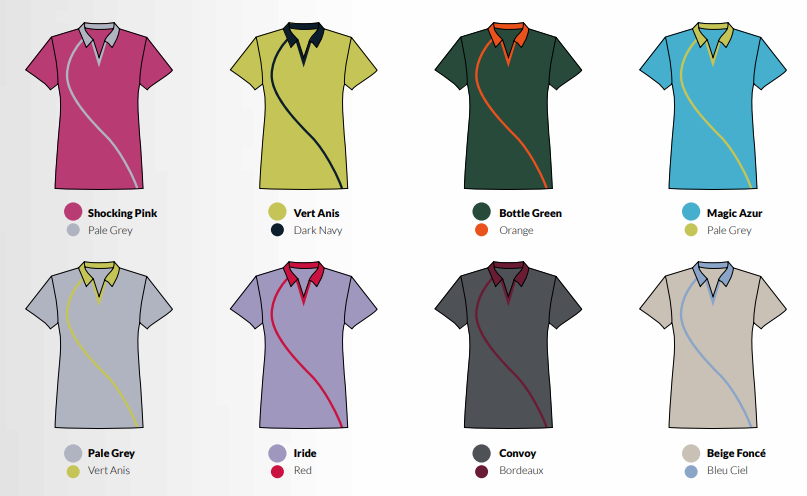
ALM works in partnership with various yarn suppliers and finishing companies in France, Europe, and Asia. Our fabrics are available in a wide range of colours (3 to 60 shades).
Some of our items are yarn-dyed (dyed before weaving), but the majority are piece-dyed (dyed after weaving using undyed yarn). In some cases, we offer garments made from printed fabrics.
The choice of dyes (reactive, vat dyes, or others) impacts the price of our products; it depends in particular on the type of fiber, the end use of the fabric, the quantity produced, and the desired quality.
We strive to prioritize vat dyes, which have the advantage of being resistant to washing at 95°C, chlorine, and light; however, they are difficult to use (a delicate and lengthy process) and expensive (expensive dyes, limited colour range). Washing temperatures are given in Celsius degree following European standards. If degrees Fahrenheit feels more familiar, a quick conversion will do the trick: "°F = °C × 9/5 + 32".
The majority of our partners use a continuous dyeing process (for large quantities): the dye bath is applied using a padding machine, followed by passage through various elements that allow the dye to fix to the fabric.

Choosing the right colour for professional attire is essential to project an appropriate image and suit the professional context. It depends on several factors, including:
- Industry sector: Sectors such as healthcare or agribusiness favor subdued colours (white, pastel), the hospitality industry prefers neutral colours (black, gray), and traditional industries often use bright colours (blue, red, yellow)...
- Type of position: Positions involving customer contact (sales, consulting) require reassuring colours (blue, beige), those working outdoors benefit from colours that blend into the environment (green), and those in hazardous environments need colours that enhance visibility (fluorescent yellow or orange)...
- Communication objective: If you want to appear approachable, opt for soft tones (beige, lavender); if you want to project authority, choose dark and neutral tones (black, brown).
- Communication guidelines: Some organizations require uniforms or specific colours, while others allow more freedom. It is important to respect the company's dress code.
Finally, remember to harmonize the colours. In a professional setting, aim for a polished appearance and avoid overly bold combinations.
Limit your outfit to a maximum of two or three colours; this prevents visual overload. Choose neutral colours as a base (black, white, gray, beige) as they combine easily with other shades.
Colours that are close together on the colour wheel offer subtle harmony: blue & green, red & orange…
Colours opposite each other on the colour wheel create a pleasing contrast: blue & orange, red & green…
Reserve bright colours (red, yellow, orange) for accents or accessories. This adds personality while remaining understated.
Neutral colour palette
We distinguish between cool neutrals (serious: bright white, pure black, cool gray) and warm neutrals (inviting: beige, light brown, off-white).
These neutral colours represent three-quarters of our fabric supplies (of which nine-tenths are white!).
Examples of neutral colours:

Super white

Pale grey

Ecru

Virtual grey

Graphite

Convoy

Charcoal

Super black

Guess brown
Colour chart
We distinguish between cool colours (calm: green, blue, purple) and warm colours (energy: yellow, orange, red).
Cool colours represent more than one-fifth of our fabric supplies (of which two-thirds are blue!).
Examples of cool colours:

Vert anis

Artic green

Kelly green

Verbena

Turquoise

Aqua

Magic azur

Blue

Petrol blue

Hospital blue

Royal box

Sailor blue

Navy

Cassis

Smokeberry
Examples of warm colours:

Iride

Prissy pink

Shocking pink

Cherry red

New emp.red

Melon

Sulphor

Primrose