Practical guide: caring for your workwear so it lasts longer
Workwear is an essential investment for any company looking to project a polished image and ensure employee comfort. Proper care helps extend its lifespan, ensure cleanliness and effectiveness, and preserve your brand’s visual identity.
In this post, we share best practices from washing to drying and steaming/ironing, along with tips for preserving professional fabrics.
Why care for your workwear?
1. A stronger brand image
- A neat appearance reflects the company’s professionalism and seriousness,
- Clean, well-maintained outfits inspire confidence in customers and partners.
2. Better garment durability
- Appropriate care preserves colors, fit and fabric strength,
- Less replacement means lower costs for the company.
3. A matter of hygiene and safety
- Effective cleaning removes bacteria, allergens and residues that can build up,
- Some professions require specific standards to ensure cleanliness and protection for workers
ü Pharmaceutical industry and laboratories (e.g. : women’s white lab coat) : to prevent product contamination and protect workers against chemical or biological substances,
ü Medical and hospital sector (e.g. : women’s tunic) : to maintain a sterile environment and protect against infections,
ü Fire and rescue professions (firefighters, first responders) : to protect against heat, flames, chemicals,
ü Construction and public works (e.g. : men’s work trousers) : to protect against falls, impacts, dust…
ü Industry (metallurgy, chemicals, etc.) : protect against chemicals, heat, mechanical hazards,
ü Food industry (e.g. : chef jacket) : for maximum hygiene to prevent food contamination…
Washing workwear: best practices
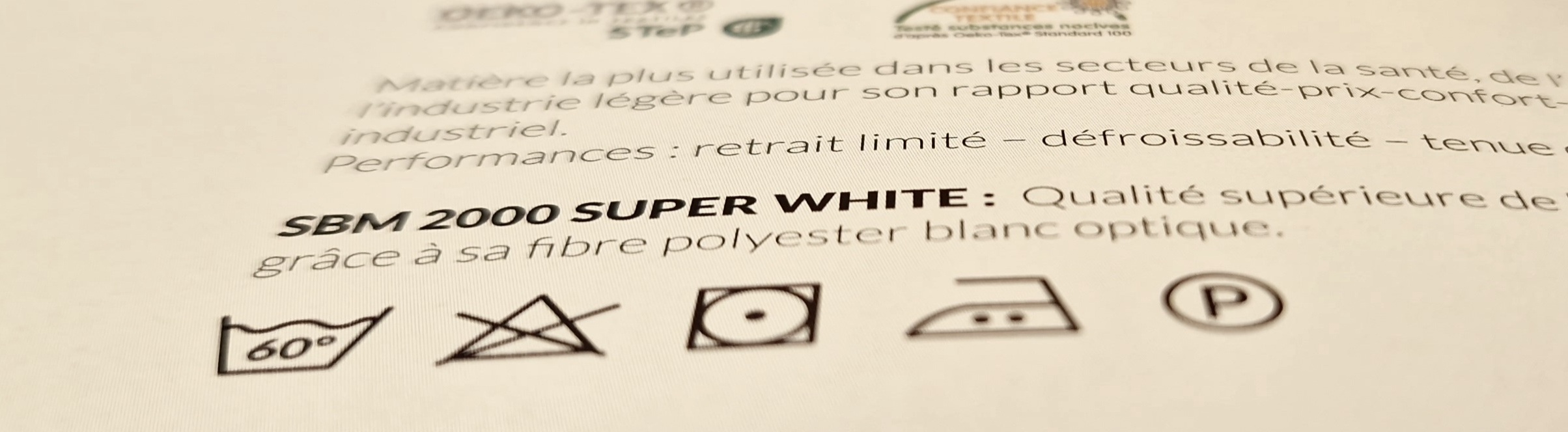
1. Read and follow the labels
- First and foremost, check the care label on each garment (and the user instructions when available),
- Follow the washing temperatures (and steaming/ironing) as well as the specific precautions for technical fabrics.
2. Sort garments before washing
- Separate colors: avoid mixing to prevent color transfer,
- Sort by level of soiling: heavily soiled garments require specific treatment,
- Take materials into account: cotton, synthetics and technical fabrics have different requirements.
3. Use suitable detergents
- Follow professionals’ recommendations (laundry product suppliers); failing that, choose a mild detergent (so as not to damage fibers) & avoid fabric softeners on technical fabrics (e.g.: waterproof, breathable garments),
- Choose an antibacterial detergent if necessary.
4. Temperature and wash program
|
Textile type
|
Ideal temperature
|
Recommended program
|
|
Cotton |
40°C to 60°C |
Normal |
|
Synthetic |
30°C to 40°C |
Delicate |
|
Technical fabrics |
30°C max |
Specific (sport/pro) |
|
Medical uniforms |
60°C |
Hygienic |
Most items offered by ALM are designed to be cared for at 60°C.
Drying and steaming/ironing : preserving fabric quality
1. Drying: air-dry or machine?
- Air-dry whenever possible to preserve fibers and limit wear,
- Use the tumble dryer (rotary dryer) with caution: choose a low temperature to avoid shrinkage,
- Avoid direct sunlight so as not to alter colors.
2. Ironing: the right moves
- Adjust the iron temperature according to the fabric.
- Use a protective cloth for delicate fabrics.
- For technical garments, opt for steam de-wrinkling (or a flatwork ironer for flat linen) rather than direct ironing.
Caring for technical and specific garments
1. Waterproof and breathable garments
- Wash with a special detergent that leaves no residue,
- Avoid fabric softener, which can clog breathable membranes,
- Reactivate waterproofing by putting the garment in the dryer for a few minutes at low temperature.
2. Lab coats and medical uniforms
- High-temperature washing (60°C) to eliminate bacteria and viruses,
- Disinfection possible with suitable products without damaging the fabric.
3. High-visibility clothing and garments with reflective strips
- Wash at low temperature so as not to damage reflective strips. Note: as part of industrial care, a mostly white outfit will not be washed under the same conditions with or without retro strip !),
- Avoid direct ironing on reflective areas.
Tips to extend the lifespan of workwear
1. Adopt daily habits
- Remove stains quickly before they set in,
- Dry laundry immediately after washing to avoid bad odors (and the risk of mold),
- Store items properly to avoid creases and premature wear.
2. Carry out regular checks
- Check the condition of seams and fastenings,
- Replace damaged buttons, zippers or hook-and-loop fasteners instead of discarding the garment,
- Repair snags or holes to prevent them from getting bigger.
Please note: some certified items have a very strictly regulated service life. A high-visibility PPE, for example, is no longer compliant beyond a certain number of washes (50 for most items offered by ALM) ; even if it looks visually fine. Indeed, high-temperature drying or ironing can reduce the durability of certain components (HV strips in particular).
With these care tips, your workwear will last longer, ensuring an impeccable image and savings on outfit replacement.
Place your order today on our ALM Textile e-commerce site and equip your employees with durable, easy-care workwear!