Key steps in garment manufacturing: from pattern making to finishing
Garment manufacturing is a technical stage of creation, production and control, combining different materials (fabrics, threads, accessories, etc.) to produce textile items (clothing, flat linen or other).
In this post, we present each stage of garment manufacturing, enabling you to make informed choices, particularly regarding items and the supplier.
Design and pattern making: the genesis of every garment
Expressing the need is the first stage of garment manufacturing. What are the requirements of the stakeholders : user (is it comfortable and practical?), specifier (is it compliant and relevant?), buyer (“is it competitive and reliable?”), payer (“is it cost-effective?”), decision-maker (“is it strategic?”)… Depending on this, an appropriate specifications document should be defined, listing quantitative and qualitative aspects that will make it more efficient to choose the items to be created.
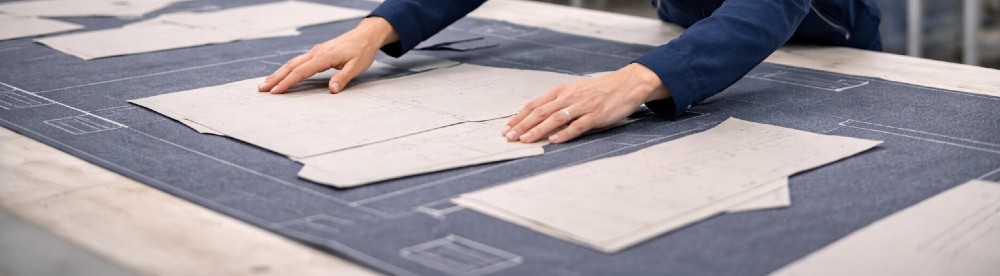
Once the model has been determined, comes the crucial pattern-making stage: creating a paper or digital template that will serve as a guide for cutting the fabrics.
- Adaptation : the pattern is designed according to the type of garment (coat, jacket, trousers). It may differ depending on the materials used.
- Fabric optimization : positioning the pieces on the fabric helps reduce waste. It takes into account, in particular, the usable fabric width of the fabrics used.
- Precision : each measurement is calculated to ensure a perfect fit. They will vary according to the size range for the same model.
A well-designed pattern is essential to guarantee the quality and consistency of the garments produced. It requires human skills (prototyping, eco-design, etc.) and technical skills (plotter, 3D modeling software, marker-making software, etc.).
Cutting: transforming the fabric
Once the pattern is validated, fabric cutting begins. This stage consists of cutting the pieces according to the pattern, ensuring the grain and direction of the fabric are respected. In some cases, certain fabric defects will need to be taken into account.
- Cutting machines or manual cutting : depending on the volume and complexity of the garment.
- Millimetre precision : each piece must match the pattern perfectly to facilitate assembly. Dimensional tolerances are specified in the technical sheets and may vary depending on the technicality of the model or the fabrics used.
- Waste management : good positioning of the pieces helps optimize material usage (use of fabric) and limit waste.
Assembly: giving the garment its shape
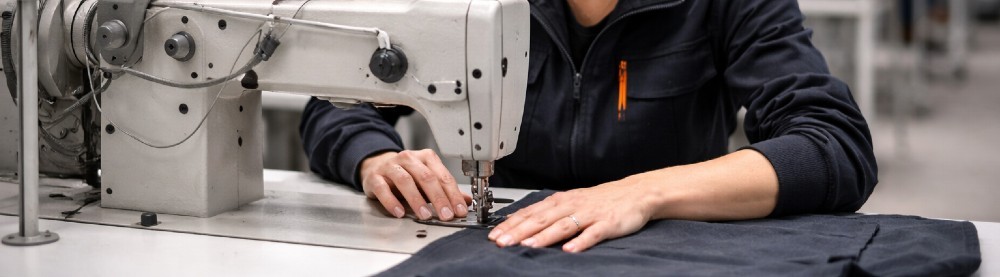
Assembly consists of sewing (and sometimes welding) the different pieces together to form the garment. This is the stage where the pattern comes to life.
- Main stitching : the pieces are assembled with machines adapted to different types of fabric but also to the models (single-needle lockstitch, twin needle, overlocker, coverstitch, etc.).
- Reinforcements and internal finishes : double seams, topstitching or reinforcements to ensure strength.
- Adaptation to use : some professional garments require specific reinforcements to withstand industrial laundering or daily wear and tear.
Careful assembly ensures a strong, durable garment, ready to withstand intensive use.
Finishing: attention to detail
Finishing is the stage where the garment becomes ready for use. It includes several operations:
- Attaching buttons, RFiD tags, markings (screen printing, embroidery, etc.) or accessories : essential for comfort and practicality.
- Ironing and shaping : to ensure a neat, professional appearance.
- Quality control : each garment is inspected to check the consistency of the seams, dimensional compliance and the absence of defects.
Finishing is the stage that guarantees the aesthetics and performance of professional workwear.
Distribution, care, repair & end-of-life recovery
The conditions for longevity and care of garments are anticipated from their design:
- Choice of materials : cotton, polyester or durable blends, suited to frequent washing and aligned with regulatory, social & environmental challenges.
- Resistance to industrial laundering : reinforced seams and fabrics to withstand intensive cycles, high washing & finishing temperatures, the use of powerful detergents...
- Adaptation to distribution constraints : the design takes into account logistics flows, packaging, storage and item traceability. Garments must retain their performance after transport, handling and frequent rotations, particularly in rental and redistribution circuits.
- Ease of repair and maintenance : sensitive areas (pockets, knees, fasteners, buttons, hook-and-loop tapes) are designed to be repaired easily. This approach extends the service life of items, limits replacements and helps control costs for operators and laundries.
- Clear and appropriate care instructions : each textile item comes with precise recommendations to preserve color, shape and mechanical properties. In some cases, particularly for PPE, specific technical requirements apply, such as a maximum number of washes guaranteeing the maintenance of performance (visibility, thermal or mechanical protection).
- End-of-life recovery : from the design phase, garments are designed to facilitate sorting, recycling or reuse of materials. Choosing compatible components and limiting complex blends contribute to a more circular and responsible approach to professional textiles.
Garment manufacturing is a complex and meticulous process. Each stage, from pattern making to finishing, helps create durable, comfortable and aesthetically pleasing professional workwear. For professionals, investing in quality garments means offering their teams or clients optimal comfort, a polished image, maximum durability, and better cost control.
To discover our full range of professional workwear and benefit from personalized advice, feel free to contact the ALM teams, who can support you in choosing textile items suited to your business and your needs.