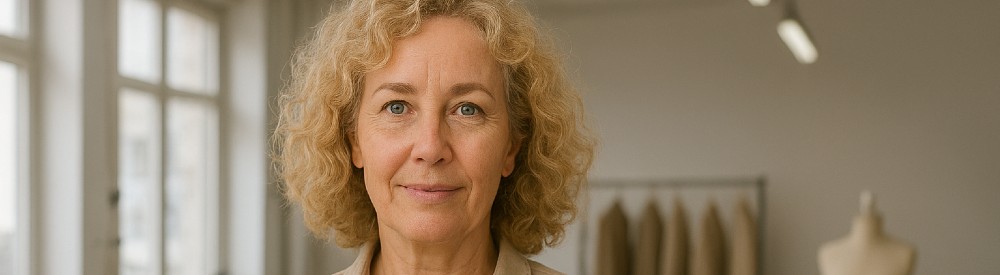
Feedback: a pattern maker’s testimonial
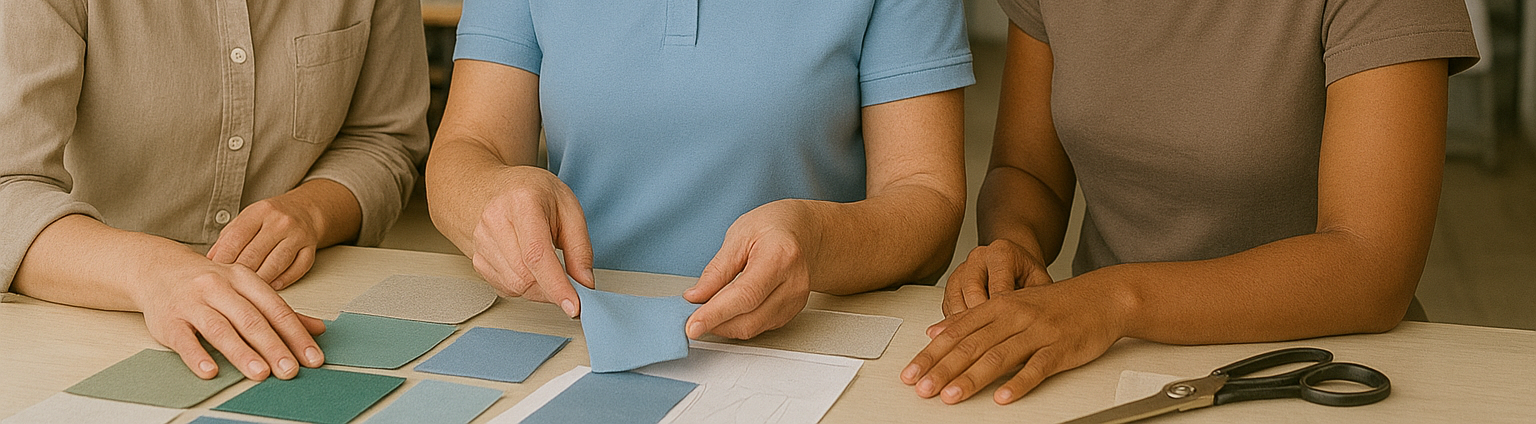
The success of a company that makes professional workwear is the combination of a fine understanding of needs, technical know-how & responsiveness. By mastering the production chain (design, pattern making, prototyping, sourcing, cutting, assembly…) ALM benefits from better control of lead times and quality, great flexibility, and a capacity for rapid innovation.
In this post, we introduce you to Karine, who is one of ALM’s textile experts. Through her testimonial, she offers us a personal perspective on a strategic role that connects creation, technical expertise, and production.
My name is Karine and I have been a pattern maker for over 25 years. I live in a small village nestled in the heart of the Hautes Vosges, a peaceful and inspiring region, conducive to creativity. My professional background is rich with varied experiences in the world of textile manufacturing, with a specialization today in professional workwear, notably in the hospital sector.
1. What attracted you to this profession ?
From the very beginning, I was drawn to the professions of fashion and textiles, and I started my journey in the field of knitwear, more specifically lingerie. This first experience allowed me to understand the importance of comfort, fit, and precision in garment cutting. I then joined an independent design office, where I had the opportunity to create patterns and grading (that is, adapting the same design to all sizes) for different fashion designers.
For several years, I have been putting my know-how at the service of professional workwear manufacturing, a demanding specialty that requires as much rigor as creativity. At ALM, every garment designed must meet precise technical constraints while ensuring comfort, durability and aesthetics. The work I do every day is essential to the successful production of each piece.
2. What are you most passionate about in your day-to-day work ?
What I love most about this profession is starting from a simple style sketch, often created by a designer or a product manager, and turning it into a concrete model, ready to be produced. It’s up to me to define the volumes, the proportions, and to imagine the garment’s technical details : pockets, yokes, hoods or even reinforcements. I can work from an existing base on screen, or copy a physical garment by digitizing it to create a digital pattern. I also sometimes make study pieces, small textile mock-ups that help validate shapes and finishes before moving on to the prototype stage.
3. What are the specific challenges of modeling professional workwear ?
My position is the first essential step in the manufacturing chain : I design the pattern, meaning all the pieces that will make up the final garment. Without this solid foundation, nothing can be assembled correctly. It’s behind-the-scenes work, but incredibly exciting, requiring both technical mastery, a good three-dimensional vision, and great precision.
Working in professional fashion also means addressing very concrete issues. The garments we create at ALM must be adapted to job-specific movements, easy to care for, durable, and sometimes even customizable. We design outfits for healthcare staff, cleaning staff, food service professionals, and maintenance technicians. Every detail matters, because these professionals wear our garments every day : their comfort and safety are our priority.
4. What is the difference between a pattern maker and a stylist (or designer) ?
Rather than talking about the differences, I prefer to talk about how complementary our roles are.
The stylist is the one who imagines the garment. She works on aesthetics: shapes, colors, materials, visual details. She is the one who creates the style sketch, a kind of drawing that gives a first idea of the model to be developed. Her work is very creative, often focused on trends, brand image, or the identity of a collection.
On my side, as a pattern maker, my mission is to turn that drawing into a feasible model. I translate the idea into concrete shapes, volumes, proportions. I create the pattern, meaning all the pieces that will make up the garment (back, front, sleeves, collar, etc.), taking into account technical constraints, ergonomics, comfort, and production. It’s very technical work, but also creative, because you often have to find solutions to respect the style intent while ensuring feasibility.
In summary, we can say that the stylist imagines the garment, and the pattern maker makes it possible. It’s teamwork: without the drawing, I couldn’t start, and without the pattern, the garment couldn’t exist!
As a pattern maker at ALM, I am proud to contribute to the quality of the garments we offer our customers. I am convinced that the technical expertise and high standards of our profession make all the difference. It is this passion for a job well done that drives me day after day, and that gives meaning to my commitment.
Feel free to send your unsolicited applications to ALM’s human resources department.