Common challenges in industrial laundry
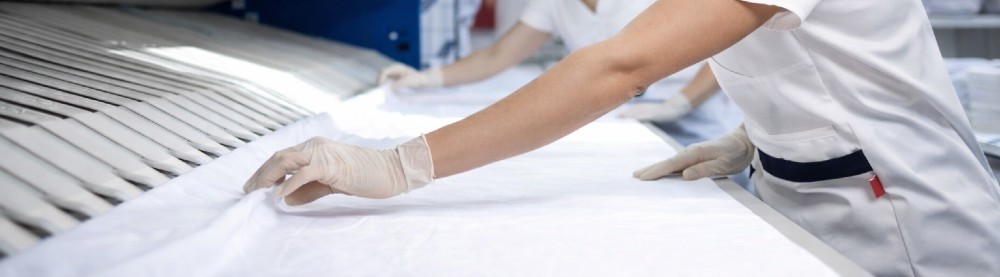
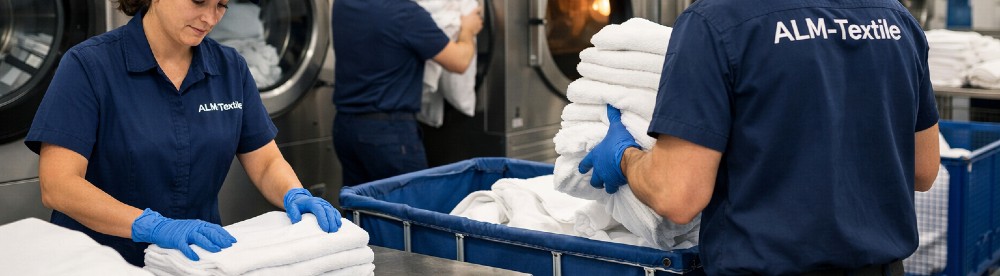
Industrial laundry plays a strategic role in many sectors of activity, such as healthcare, hospitality, industry or services. It ensures the hygiene, availability and quality of professional textiles used every day. However, this activity is subject to strong operational, economic and regulatory constraints.
In this post, we identify the main challenges faced by industrial laundries and share practical ways to optimize flows, keep teams safe, ensure service continuity and extend the lifespan of professional textiles.
Managing large daily volumes
One of the first challenges in industrial laundry is managing very large volumes of linen. Flows are constant and sometimes subject to intense peaks in activity. This logistical pressure requires rigorous organization at every stage of the cycle.
Delivery, collection, sorting, washing, drying, folding, repair and redistribution must be perfectly coordinated. Poor anticipation can quickly lead to delays or stockouts for customers.
To address this, many laundries invest in:
- Detailed planning of inbound and outbound flows,
- Linen traceability tools,
- Standardization of the items processed.
Maintaining equipment performance
Industrial laundry equipment is subject to intensive use. Washing tunnels & washers, finishing tunnels, dryers, ironers & folders often run continuously. Their reliability is a major issue.
Maintenance is a daily challenge. A breakdown (or worse : a failure) can slow down the entire production chain. It generates significant direct and indirect costs.
Best practices include:
- Training teams in how to use the machines.
- Regular preventive maintenance.
- Choosing reliable partners for equipment, spare parts, detergents or textile items.
Ensuring impeccable hygiene
Hygiene is at the heart of industrial laundry requirements, especially in healthcare and the agri-food sector. Washing protocols must effectively eliminate contaminants while preserving textiles.
This challenge is reinforced by:
- The diversity of textiles processed : soiled linen from nursing homes, meat or fish cutting workshops, laboratories…,
- Strict health standards : Risk Analysis and Biocontamination Control (RABC), ISO 22000 (improving traceability and risk management in the food-related laundry process), NF EN 14065 (ensuring the microbiological cleanliness of linen & preventing cross-contamination risks),
Choosing fabrics that withstand high temperatures and repeated treatments is crucial. It helps ensure consistent hygiene without premature degradation of items.
Ensuring team safety
Workplace safety is a major issue in industrial laundries. Operators are exposed to several risks: handling loads, heat, chemicals, wet floors.
Prevention involves:
- Appropriate protective equipment.
- Ergonomic workstations.
- Workwear designed for safety and comfort (especially in a hot, humid or noisy environment).
Durable, well-cut outfits suited to the work environment help reduce accidents and fatigue. They also contribute to enhancing the value of laundry professions.
Controlling operating costs
Industrial laundries have to deal with high costs. Energy, water, detergents, labor and linen replacement represent major expense items.
The pursuit of economic efficiency is ongoing. It involves in particular:
- Retaining existing staff,
- Choosing equipment & mastering processes : a tunnel dedicated to garments separate from that for flat linen ? a tunnel dedicated to light-colored linen separate from that dedicated to dark linen ? adding chips or barcodes to items ? optimizing wash cycles…
- Reducing losses and textile waste,
- Extending the lifespan of professional garments…
Meeting environmental requirements
Environmental issues are increasingly present in the industrial laundry sector. Beyond institutions, customers, contracting authorities and even staff expect responsible practices.
The main challenges concern:
- Reducing water and energy consumption,
- Controlling chemical discharges,
- Managing textile waste.
Managing the diversity of customers and uses
Industrial laundries work for customers with very diverse needs. Each sector imposes its own requirements in terms of textiles.
Healthcare, industry, hospitality or services have different constraints. This diversity complicates stock and process management.
One solution is to:
- Offer standardized, versatile textile ranges,
- Have a central warehouse to pool purchasing and logistics,
- Work with partners capable of adapting products.
An experienced manufacturer is an asset in meeting these multiple expectations.
The key role of textiles in overall performance
Textiles are often seen as a simple consumable. In reality, they play a central role in the performance of an industrial laundry.
A well-designed professional garment or linen item:
- Withstands intensive washing better.
- Maintains its properties over time.
- Facilitates processing and logistics operations.
That is why ALM teams are particularly involved in the issues of :
- Rigorous selection of materials.
- Design adapted to intensive use.
- Close collaboration with field stakeholders.
Industrial laundries face many challenges, but each of them can become a lever for improvement. Efficient organization, reliable equipment and suitable professional textiles help secure operations and optimize costs.
If you would like support in a sustainable performance approach, contact the ALM teams now. They will offer you durable, high-performance textile solutions tailored to the challenges of your professions.